

In 1936, aeronautical engineer Theodore Wright published a paper in the Journal of Aeronautical Sciences. While studying aircraft manufacturing, he noticed every time production of an airplane model doubled, the labor cost per unit fell by a predictable 10-15%. Over time, workers get faster, waste disappears, and negotiation power of suppliers increase. This phenomena is defined by Wright’s Law.
Physicists understand the world through laws. Through principles rigorously proven to be fundamental to a topic. Likewise, when studying the business we’ll get into today, I felt understanding the laws of its industry would help in revealing understandings the market tends to miss.
Fast forward 90 years, and Wright’s Law stands today. The company is Espey Mfg. & Electronics Corp.
And quite genuinely, I find it to be one of the most elegantly structured small businesses I have ever looked at.
Background
Espey (NYSE American: ESP) is a 170-person manufacturer in Saratoga Springs, New York. They build products under two buckets: magnetic components and power electronics, both for naval ships and aircraft. Magnetic components include specially designed transformers, inductors, and power distribution panels.
Power electronics include various power supplies, converters, and inverters.
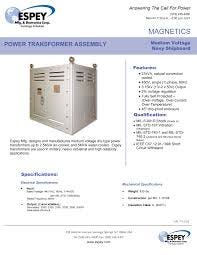
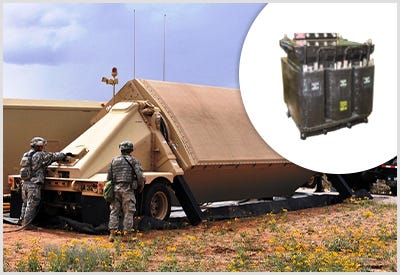
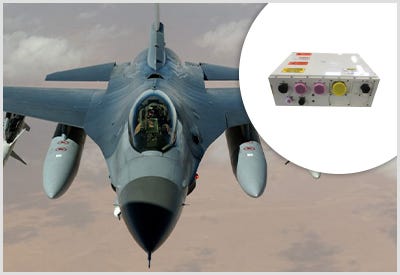
We’ll get into more detail in a later section, but the underlying idea is that the hardware is mission-critical; it must work perfectly. Otherwise lives are lost.
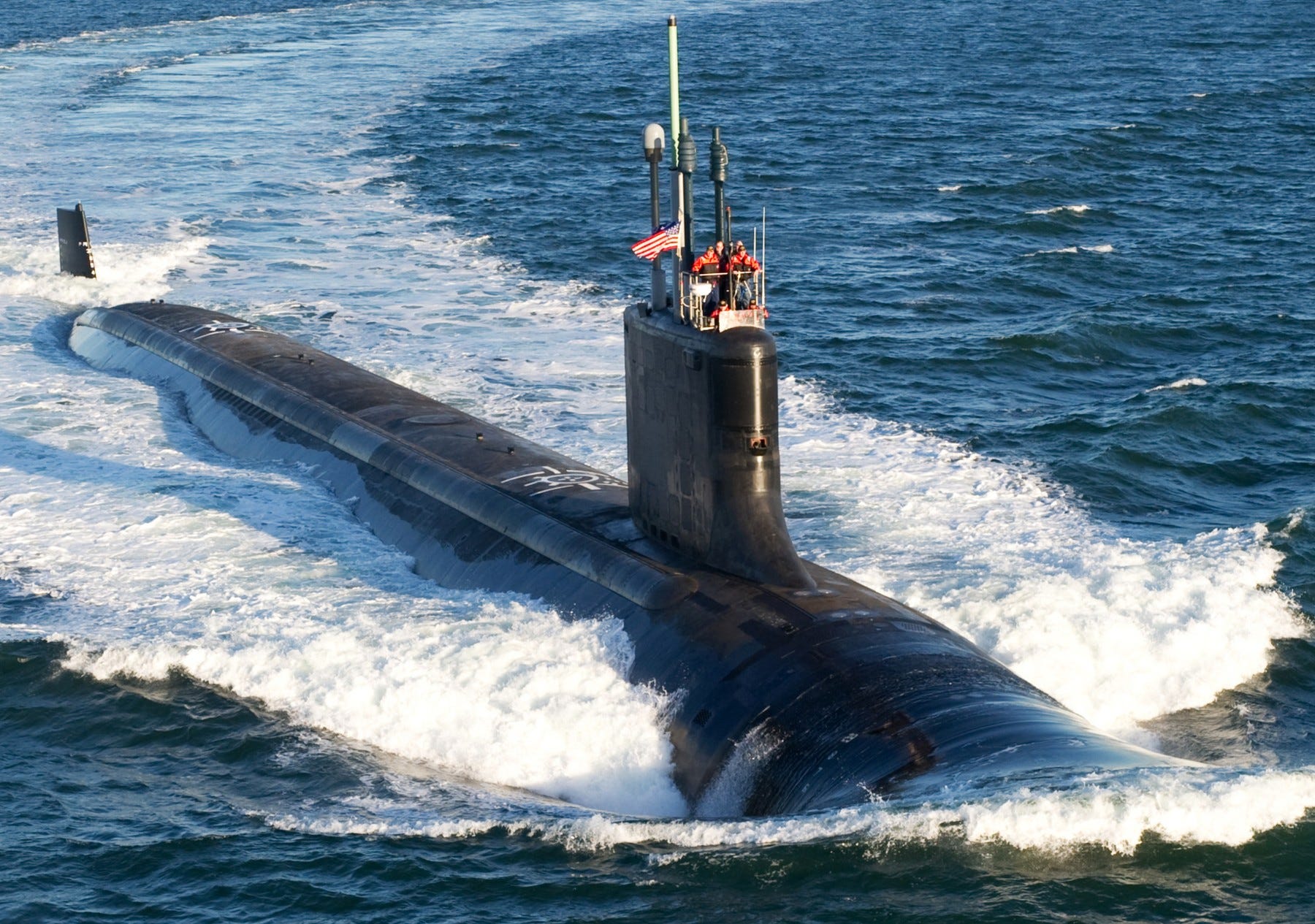
Their primary customer is the United States Navy. At this point in time, the two primary programs are the Virginia class nuclear-powered attack submarine and the Columbia class nuclear-powered ballistic missile submarine.
If those two sentences are not immediately remarkable to you, they should be. The Virginia class has 26 active hulls, each costing approximately $5 billion. The Columbia class carries the sea-based leg of the United States nuclear deterrent, 16 Trident D5 missiles per hull, with 12 planned at roughly $9.4 billion per follow-on boat. These ships are how America maintains its military triad. Nuclear deterrence doesn’t exist without them.
Espey is a sole-source supplier on both programs. No one else provides nor can provide what Espey does.
The Moated Structure
Phase 1: engineering. A classic representation of the upfront burden. Espey bids for the right to design and/or quality a specific component of a ship, submarine, or aircraft. Think various transformers or power distribution systems. To say the least, such contracts aren’t lucrative. They require the aggressive, expensive hiring of qualified engineers, years of painstaking technical work, and the rather dull process of working with the Navy. The margins in the engineering phase are thin-to-negative. Very few understand that this is the first step in the lifecycle for Espey.
Phase two: early production.
Once Espey’s design is certified and integrated into a platform, the Navy faces arguably the most difficult problem of all; scaled manufacturing. Qualifying a manufacturing process involves years of vibration testing, electromagnetic compatibility and calibration, environmental qualifications, and even setting up Navy oversight over the process. Letting in an unqualified supplier is a tough pill to swallow; and with Espey as an option, the Navy very rarely looks the other way.
The legal mechanism is the sole-source contract. Only one responsible source can manufacture the given product for the entire life of the program.
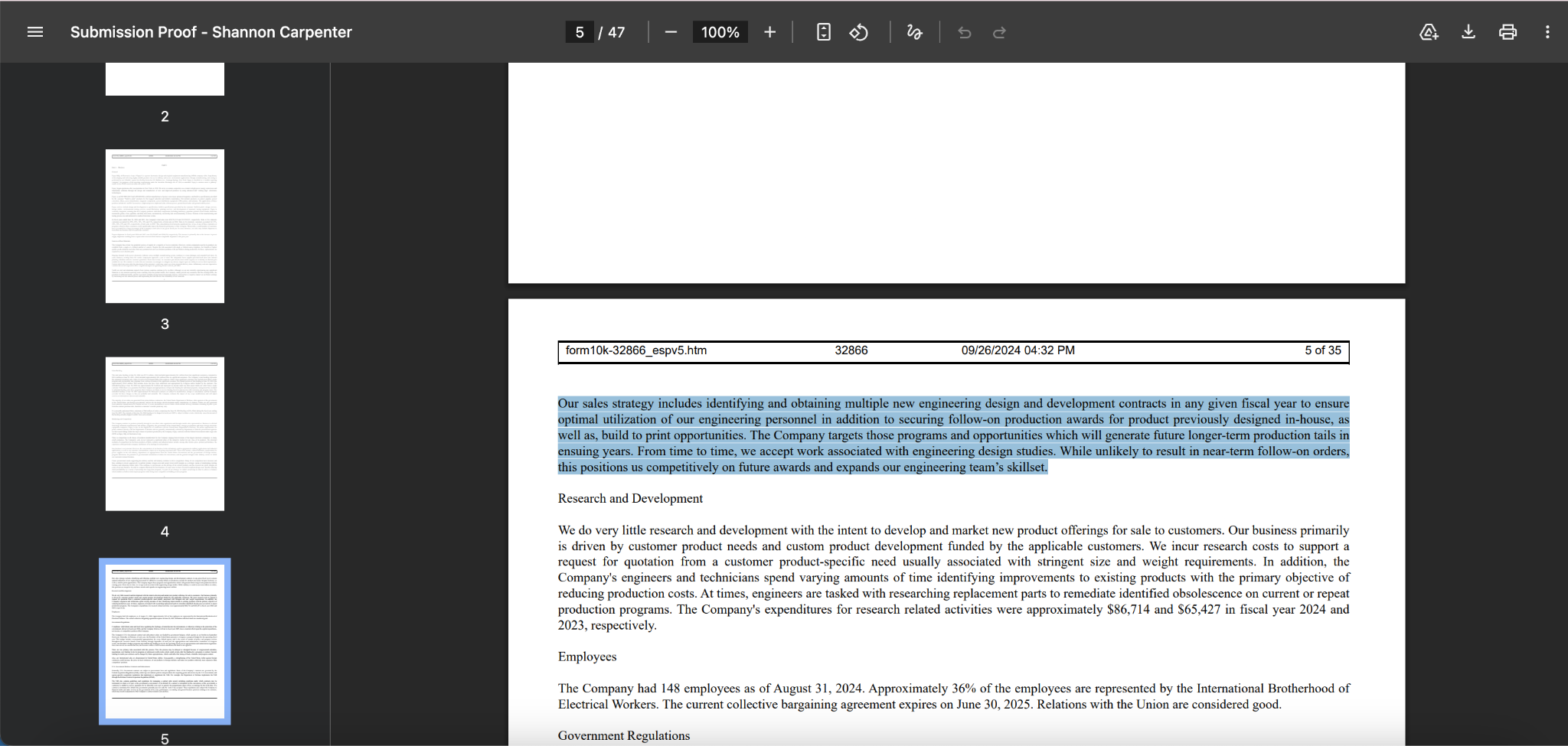
The Virginia class runs through at least the 2040s. The Columbia class runs through the 2080s.
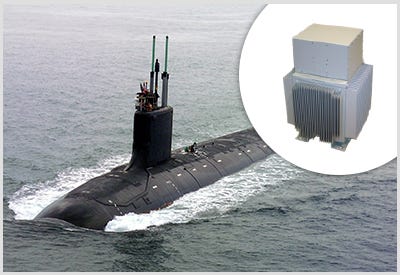
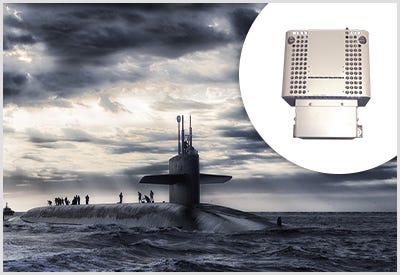
Competitors cannot undercut Espey on price. They cannot negotiate their way onto the program. The only displacement path is funding an entirely new qualification effort with years of testing. The structural switching cost is permanent and prohibitive.
Phase 3: Wright’s Law
Just like Theodore Wright and aircraft manufacturing, Espey’s production contracts are fixed-price. The Navy locks in a price per unit at the start of the production run, and that price does not move. If Espey’s costs rise, they absorb the difference, and many are pushed away by that structure’s presumed fragility. I believe it’s an extraordinary structural advantage.
Think about what fixed-price actually means once a program hits maturity. Espey has built Virginia class transformers hundreds of times. They know the exact cost of every component. They know precisely how long every production step takes. They know where the historical waste was and have systematically eliminated it. The cost to produce is known to a high degree of precision. Every subsequent efficiency gain across labor, raw material, or accuracy adds to margins and never goes away.
This is Wright’s Law. Espey keeps every dollar of cost compression it generates, whether that’s through faster workers, tighter processes, or lower material waste.
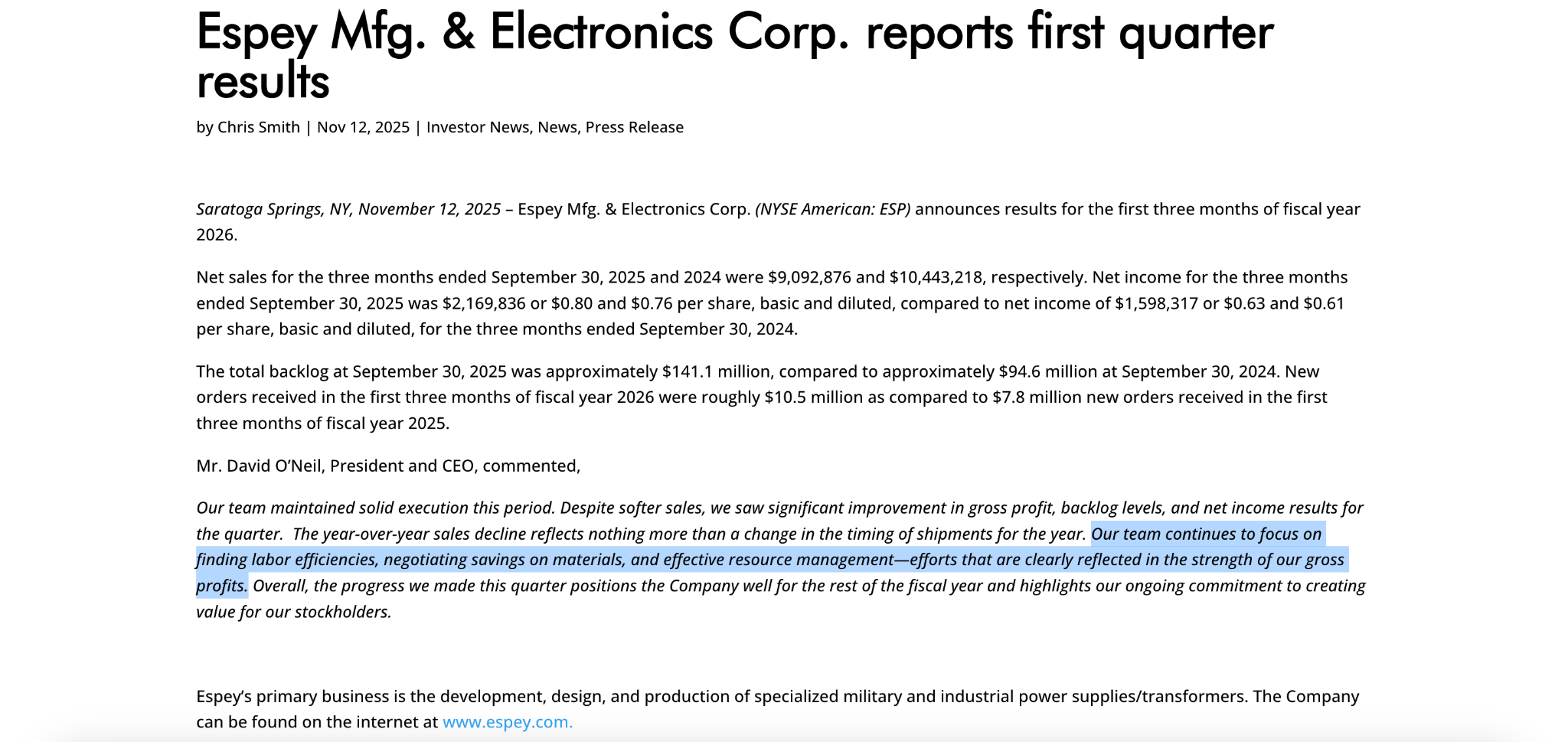
The financial proof is in the filings. In Q1 FY2026, Espey’s revenue fell 13% year over year. Yet their net income rose 36%. Through nine months of FY2026, gross margin expanded from 25.9% to 35.7% on revenue that was actually down. That simply cannot be operating leverage. That is the learning curve compressing costs on fixed-price contracts while the selling price holds. In FY2025, revenue grew 13.5% and net income grew 40%. Management concurs:
The natural risk with a fixed-price structure is what happens when costs rise from external factors. Costs increase on a fixed revenue base, and naturally, margins collapse. It’s an inevitable facet of Espey’s business and something that must constantly be monitored. On the bright side, as product lines mature, they see permanent incremental margin boosts and better resist macro volatility. The main overrun risk comes in engineering contracts. Luckily, just 11% of Espey’s current backlog is engineering. The remaining 89% in production weighs Espey’s product mix towards anti-fragility. And in exchange for this fixed-cost structure, the Navy gives them something very few businesses in the world get.
Growing on the Navy’s Buck
Espey does not just produce for the Navy. In a very specific sense, the Navy finances Espey’s operations. Under the Federal Acquisition Regulation Part 32, the government pays contractors upfront progress payments of up to 80% of costs incurred. In plain English: the Navy pays Espey before Espey fully makes or ships the product. That cash sits on the balance sheet as a liability until the unit ships and revenue is formally recognized.
The result is what I would call a supplier float business. Think of it like an insurance company that collects premiums before it ever pays claims, or a retailer that sells gift cards before it buys inventory. The customer’s money funds the operations. The business grows without needing external capital.
As of March 31, 2026, Espey carried $33.5 million in unearned revenue. Simultaneously, inventory rose to $26.6 million — physical proof Espey utilized upfront payment to fund production and eliminate the need for dilution or leverage. As an investor, your edge is in staying ahead of the income statement. Judging Espey on lumpy quarterly numbers ignores the structural strength no one values.
Not to mention, this unearned revenue acts as a catalyst for the next couple results. Ultimately, that revenue must book on the income statement, and given the rather stale sentiment from a timing-related revenue slowdown, things could get interesting.
The payoff isn’t hypothetical. Espey carries zero long-term debt and $46 million in cash. They use the Navy’s money to generate real profits and cash flows for shareholders. That’s a quality business in my eyes.
The Navy’s Buck doesn’t stop there. In FY23, the Navy awarded Espey a $7.4 million grant to build a new facility. In fiscal year 2025, the Navy added $3.4 million more for testing facility upgrades. In October 2025, full-scale operations began at the resulting 24,000-square-foot Magnetics Center of Excellence. The Navy effectively built Espey a factory! Think about that.
When your customer builds your factory, they are indirectly outlining their dependence on you. The market seems to have missed that.
What Management Actually Knows
Here is something I find absolutely remarkable for a contract-based business – that too one that works with the U.S. government! Visibility.
On June 30, 2025, management published guidance that approximately $49.1 million of the backlog would be recognized as revenue in FY2026. A specific number, given publicly, based on the delivery schedules embedded in signed, funded government contracts. They know when the Navy has scheduled delivery acceptance on each unit. For a business not only working with the government, but working under a typically lumpy, contract structure, I find such transparency to be phenomenal. And it extends many years into the future.
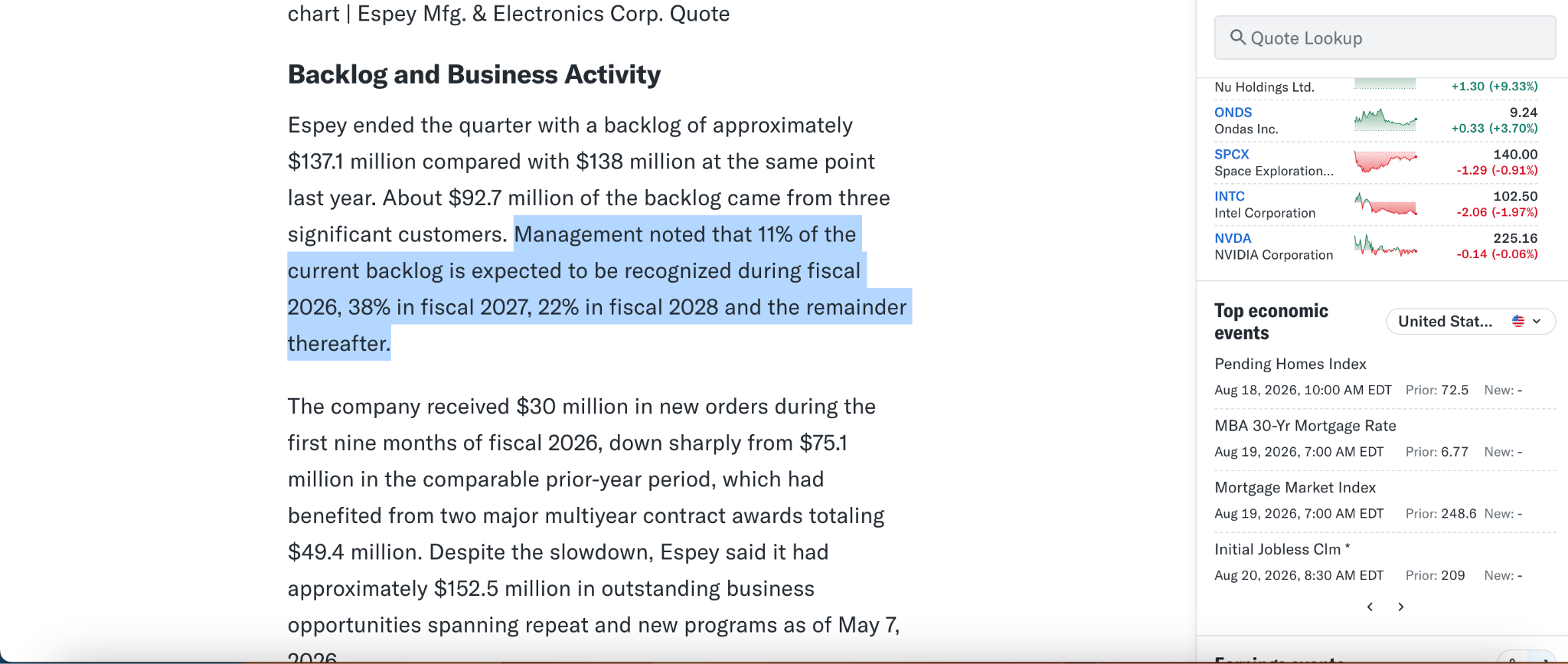
Espey has the visibility to forecast backlog conversion till 2028. Most investors have to worry about book-to-bill, and the various implications of a rising or declining backlog. Not with Espey. You’ll notice this conversion itself guarantees 10-15% annual revenue growth alone, and that’s not accounting for margin expansion or the other massive opportunities ahead.
The Backlog, the Pipeline, and the July Catalyst
$122.6M of their $137M backlog is fully funded by government dollars. A year ago, backlog was $97M, meaning backlog grew 44% in a year, without a major macro push. Fy25 saw $86.4M in new orders, and included a $19.8M sole-source contract for Virginia and COlumbia class submarine transformers awarded in April 2025.
Beyond the backlog, Espey disclosed in its May 2026 10-Q a $152.5 million outstanding opportunity pipeline. These are active applications and upcoming programs management pursues. That figure had actually been $163 million as of August 2025 per the annual report, and though it’s a slight decline, it makes it clear to me this isn’t some hypothetical analyst projection, but rather an active KPI management tracks.
Importantly, that $152.5M opportunity pipeline was disclosed before the largest submarine contract in American history was announced.
On July 29, 2026, the Navy awarded $76.6 billion in submarine procurement: $42.1 billion for nine Virginia Block VI attack submarines and $29.5 billion for five Columbia Build II ballistic missile submarines. The money flows from the government to General Dynamics Electric Boat and Huntington Ingalls as primes, then down the supply chain to the qualified sole-source subcontractors. While typically a rather minute portion of the overall funding ceiling reaches Espey’s income statement, for an $180M critical defense manufacturer, it makes a big impact. Especially when we know Espey is specifically the monopolized supplier of transformers and various other power transmission products for the Columbia and Virginia Fleets. Espey enters these resulting buildouts with optimized production costs as per Wright’s Law: in simpler language, they enter them in Phase 3. That means higher margins and better predictability.
These awards not only act as a catalyst for the next couple of results, which ideally should reflect the backlog growth, but also confirm the Trump Administration’s broader push for maritime strength amid conflict in the Strait of Hormuz.
Rinse-and-Repeat
A question remains. The contracts given or in the opportunity pipeline surround a select suite of products Espey specialize in. But at some point Espey will hit a ceiling, right? Not exactly.
We’ve established that Espey’s engineering contracts aren’t structural weaknesses but rather long-term investments. They seed a future sole-source production monopoly that will drive decades upon decades of high margin profits for shareholders. Right now roughly 11% of Espey’s backlog are in such contracts. We can look to history to see why current success will sustain. Espey was the sole transformer supplier on the Ohio class till 2016. As Ohio wound down, they moved into a Virginia engineering contract. Once again, margins compressed from intensive R&D and uneconomical manufacturing. Now Virginia production is mature and generating the 35%+ gross margins we see today, while Columbia class engineering transitions toward production.
FY2025 revenue came from three simultaneous platform categories: shipboard transformers for submarines and surface combatants, power systems for combat vehicles, and power systems for aircraft radar and missiles. There was a time in which Espey was solely defined by one of the above categories. We know the engineering contracts of the future further diversify away from where Espey is now – and over time, we’ll likely see a robust Espey with magnitudes more earnings power.
The Next Growth Layer: BESS and Directed Energy
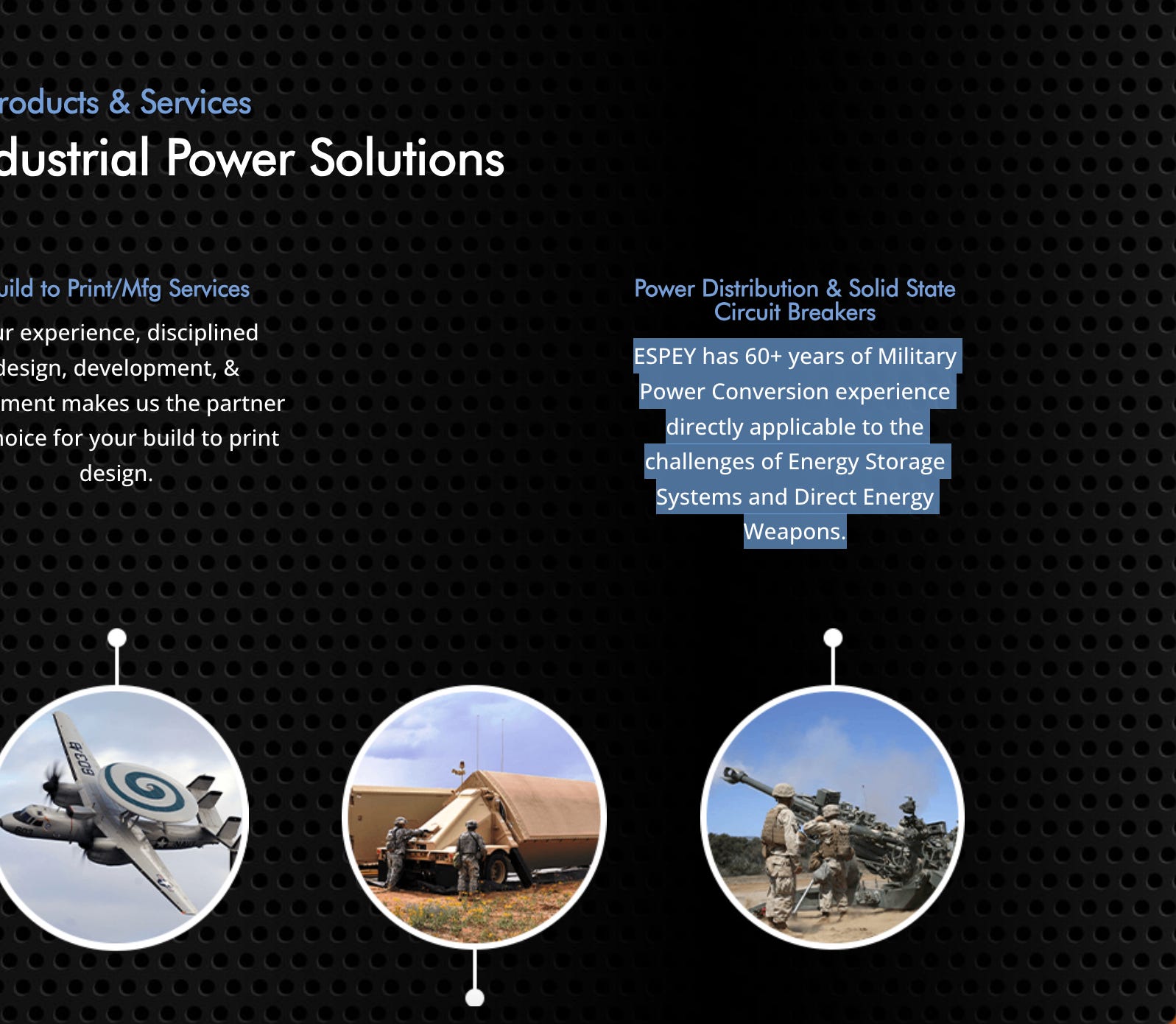
The DoD’s directed energy roadmap targets power levels scaling from 150 kilowatts today to 500 kilowatts between 2025 and 2030, and ultimately to megawatt levels thereafter. Ultimately, the power transmission components that surround such devices will be exponentially more important. Espey is an expert in the sector, the Navy’s go-to supplier, and has publicly established the market as an area of interest.
Battery Energy Storage Systems for defense present the same adjacency. Military BESS opens up a new, highly-funded market for transmission ESP sits comfortably in. Neither of these is baked into the current revenue model. But very frankly, a single deal could entirely re-rate the stock – it opens up a new, exciting domain and opportunity for investors to remodel.
The Multiple Problem
Defense electronics peers typically trade at very different multiples than Espey.
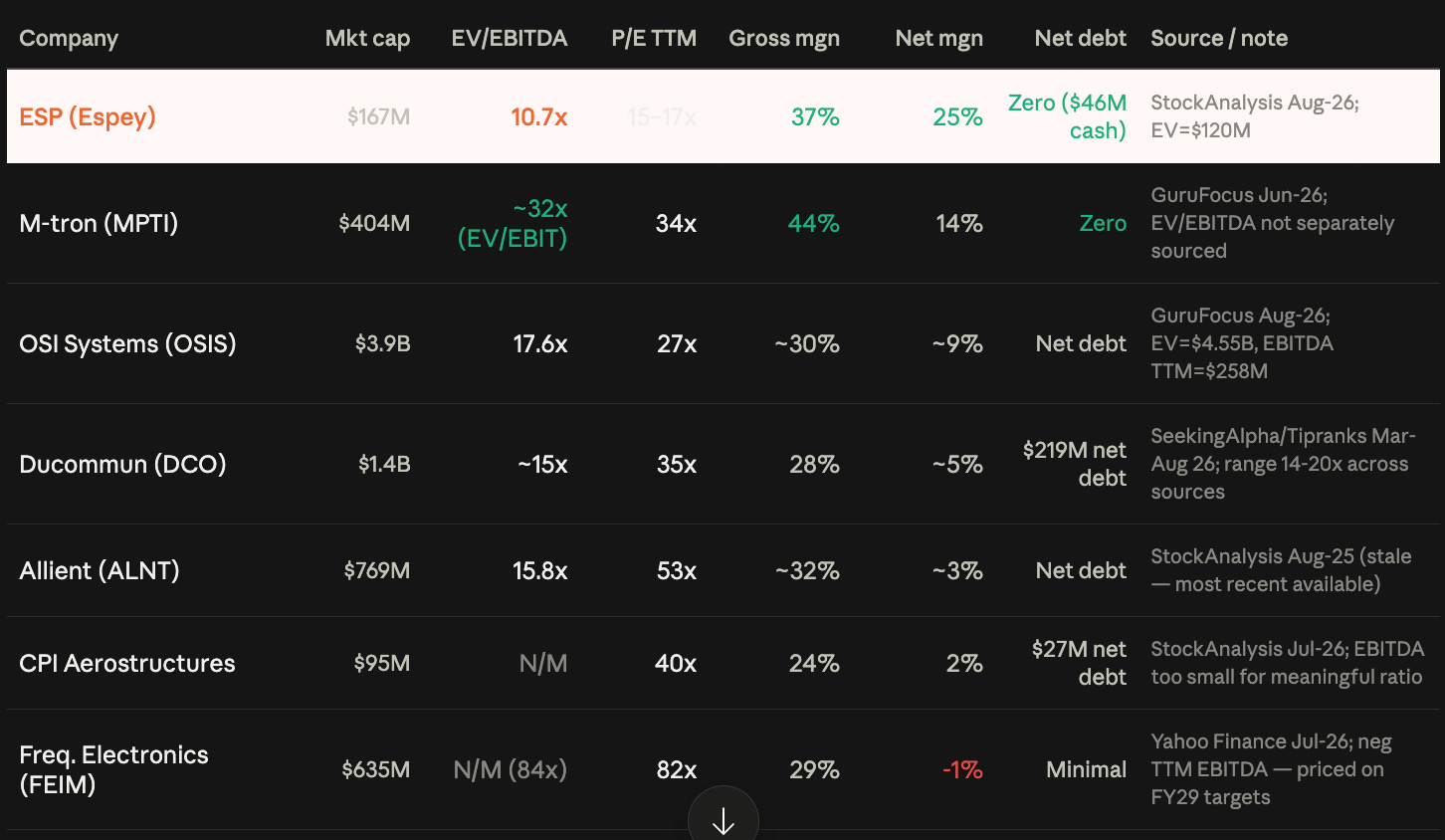
Espey, with 89% of backlog in funded production contracts and gross margins expanding toward 36%, is not being valued anywhere near the average. The reasoning is mechanical: there are no sell-side analysts, it’s too small, and for most funds it’s simply too illiquid. But that’s where retail investors can take advantage. My valuation centers around accelerated earnings growth under the July orders and a re-rating towards un-hyped defense peers at 25-30x earnings. A blast-off towards hype multiples in the case of material directed-energy participation is a call option.
Currently:
Stock at roughly $64, approximately 2.8 million shares outstanding, market cap around $180 million.
Net cash of $46 million.
Enterprise value of approximately $147 million.
Trailing net income of $10.8 million → trailing EV/net income of roughly 13.6x
Sales have grown at a 13% CAGR in the last 4 years. Margin expansion has driven a more violent multiplication on the bottom line, bringing net income from $1.3M to $10.8M in 5 years. I believe a conservative 20-25% earnings CAGR will sustain going forward. Remember, management has incredible visibility on backlog conversion, guiding for 38% of the $137M backlog to convert in 2027. That alone yields a $52M top-line, 18% higher than that of FY25. A higher portion of Columbia/Virginia contracts increases the margin mix, while engineering seeds future value creation. In the highly conservative case, a 24% Net Margin brings $12.5M net income. On $60M from opportunity pipeline-conversion, we get $14.5M. On $68M in the bull case, where the July awards kick in under accelerated timelines from middle-east tensions, reports ~$16.5M. At 25x, that’s $105-140 per share. At 30x, that’s $130-$165 per share. I think these are more than reasonable for 2027.
What Can Go Wrong?
Well, it’s a contract business. Revenues are lumpy, projects get delayed, and trailing screeners are thus highly misleading. Virginia class has been running at roughly 1.1 to 1.2 boats per year rather than the targeted two boats per year since 2022, driven by workforce and supply chain constraints at the shipyards. A delay at the yard pushes Espey’s delivery timing.
Engineering contracts carry overrun risk and can weigh down blended margins. The 11% of backlog in engineering could be surprisingly sustainable or baneful.
And the re-rating depends on discovery. Espey has 144 followers on TipRanks. No one knows whether it will happen, let alone when.
ESOP dilutes roughly 7% per year, so if growth stagnates, know what’s working against you.
Conclusion
Wright’s Law has been working inside Espey’s fixed-price production contracts for over fifty years. The $137.1 million funded backlog guarantees it keeps working for at least three more. The $76.6 billion July award guarantees it keeps working for decades after that.
In my opinion, the name of the game here is risk-to-reward. Espey has unprecedented visibility over its operations, has a legally defined moat, utilizes Navy money for nearly infinite ROCE’s, structures itself for long-term success, and returns capital back to shareholders. All at 60% below the peer-average multiple.
Viewing the world through laws the way physicists do allows us investors to turn the market’s trash into treasure. Wright’s law reveals a hidden asset in a seemingly fragile fixed-price structure, and going forward, I’ll certainly view such businesses with more nuance. But overall, I see 2-3x upside in Espey in the next 12-24 months on an extremely attractive risk profile.
I am long ESP. This is not financial advice. Do your own research before making any investment decisions.
Really well-constructed piece — the Wright's Law framing is a sharp way to explain why margins are expanding on declining revenue, and tying the FAR Part 32 progress-payment mechanism to a "supplier float" model is a genuinely useful lens most coverage of this name misses entirely. The backlog visibility section and the July $76.6B award context add real substance too.
One thing worth tightening: the sole-source claim ("no one else provides nor can provide what Espey does" on both programs) is a bit broader than what I can trace back to source. Espey's own site states they're "the sole source of supply of distribution transformers for several important Naval submarine and surface combatant applications" — which supports sole-source status for that specific product line, but doesn't quite establish it across everything Espey supplies to both platforms. Worth citing the specific scope (transformers/distribution equipment) rather than the blanket framing, or pointing to a GAO/DoD sole-source justification if one exists that I missed.